China’s digital ecosystem is fundamentally different from Western markets. The platforms, search engines, social networks and payment systems that work in Europe or North America are either blocked, irrelevant or have Chinese-only equivalents. Effective China marketing starts with understanding this landscape — and building a strategy around it rather than attempting to replicate a Western approach.
Start with the Right Foundations
Before choosing tactics, every brand entering China needs four foundational pieces in place. Skip any of them and the rest of your marketing budget delivers diminishing returns.
- Simplified Chinese first. Every marketing touchpoint must be in Simplified Chinese — your website, ads, social media and customer communications. Professional translation is the minimum; natural, culturally adapted copy by native Chinese writers performs significantly better.
- China-hosted website. A site hosted on servers inside or near China loads dramatically faster for Chinese users. Slow sites lose visitors before they read your content. Google-hosted assets (fonts, analytics, maps) are blocked and will break page load.
- Chinese payment methods. If you sell online, you need Alipay and WeChat Pay. Chinese consumers rarely use international credit cards for domestic purchases. Without these payment options, your conversion rate will be near zero.
- Mobile-first design. Over 70% of Chinese internet users access the web on mobile devices. Your Chinese website and landing pages must be optimised for mobile screens — desktop-first designs fail in China.
Which Platforms Matter in China
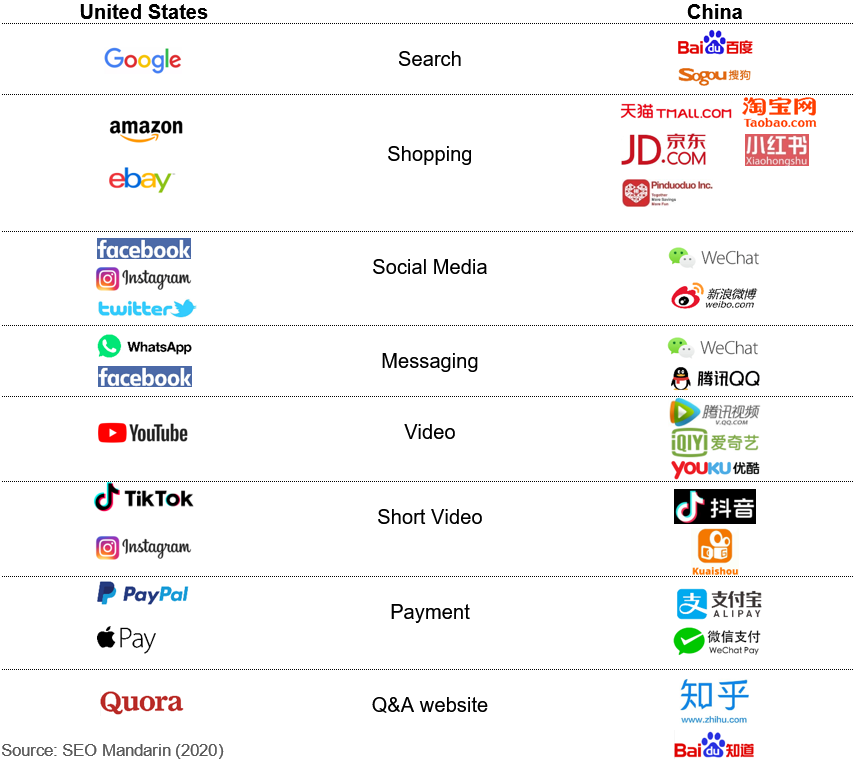
China’s “internet” is really a collection of dominant platforms — most of them direct equivalents of Western services that simply don’t operate in mainland China. The chart below maps the most important ones; the table beneath it explains the role each plays in a marketing mix.
| Platform | Role | Why it matters |
|---|---|---|
| Baidu (百度) | Search | China’s dominant search engine with 76%+ market share. Baidu SEO and Baidu PPC are the primary channels for capturing intent-driven traffic. |
| WeChat (微信) | Social & messaging | 1.3 billion+ monthly users. An Official Account lets you publish to followers, run targeted ads and integrate mini-programs for e-commerce or lead capture. |
| Weibo (微博) | Social media | China’s Twitter equivalent — public, broadcast-first. Effective for brand awareness, KOL collaborations and reaching young urban consumers. |
| Xiaohongshu / RED (小红书) | Social commerce | Lifestyle and product discovery, popular with young women. Drives purchase decisions in beauty, fashion, food and travel. |
| Taobao / Tmall (淘宝/天猫) | E-commerce | China’s dominant marketplaces. Taobao suits smaller brands and new entrants; Tmall provides premium positioning for established brands. |
| Douyin (抖音) | Short video | The Chinese TikTok — same app, separate data. 600M+ daily active users, increasingly important for product discovery and live-stream shopping. |
KOL Marketing in China
Key Opinion Leaders (KOLs) — China’s equivalent of social media influencers — play a central role in Chinese consumer purchase decisions. Chinese consumers are highly sceptical of direct brand advertising but trust recommendations from KOLs they follow, particularly in beauty, food, fashion and consumer electronics.
KOL marketing in China works differently from influencer marketing in Western markets:
- Micro-KOLs (50,000–500,000 followers) often drive higher engagement and conversion rates than mega-KOLs, at a fraction of the cost.
- Platform matters. The right KOL on Xiaohongshu reaches a very different audience from the same KOL on Douyin or Weibo.
- Long-term partnerships outperform one-off posts. Chinese audiences notice when a KOL repeatedly endorses a brand — that consistency builds purchase intent.
10 Common China Marketing Mistakes
Most failed China launches fall into one or more of the same traps. Audit your strategy against this list before signing off on a budget:
- Assuming Google SEO expertise transfers to Baidu — different algorithms, different signals.
- Launching a Chinese website with machine-translated content — Baidu penalises unnatural Chinese.
- Ignoring mobile — over 70% of Chinese internet users access the web exclusively on mobile.
- Expecting Facebook and Instagram to reach Chinese consumers — both are blocked in mainland China.
- Using the same brand messaging as in Western markets without cultural adaptation.
- Setting up a WeChat account but publishing in English — defeats the purpose entirely.
- Underestimating response time expectations — Chinese B2B buyers expect replies within hours.
- Hosting a Chinese website on overseas servers — slow load times destroy conversion rates.
- Running paid ads without Chinese landing pages — sending Chinese traffic to English pages wastes budget.
- Treating China as a single homogeneous market — Tier-1 and Tier-3 city consumers are very different.
Building a Realistic China Marketing Budget
China marketing requires investment in both setup and ongoing execution. Key cost components to plan for:
- Chinese website development and hosting (with ICP licensing if hosted in mainland China)
- Baidu advertising account setup and ongoing management fees
- Native Chinese content creation — translation alone is not enough
- WeChat Official Account setup, certification and monthly content
- Optional KOL fees, Xiaohongshu seeding, Douyin video production
Brands that try to enter China on minimal budgets by cutting corners on localisation consistently underperform. Chinese consumers immediately recognise poor-quality Chinese content and do not trust brands that demonstrate little understanding of their market. Doing it properly from the start costs less than fixing a failed launch.
Ready to Build Your China Marketing Strategy?
SEO Mandarin has been helping foreign brands market to Chinese consumers since 2012. Our team handles the full stack — Baidu SEO and PPC, WeChat, KOL campaigns, Chinese web design, e-commerce and translations.