DeepSeek is only the #3 AI assistant in China. And the companies you’d least expect are already running their business on Chinese models. Here’s the map Western media never updated.
Ask anyone in the West to name a Chinese AI company and you’ll get one answer: DeepSeek.
That mental picture froze in January 2025, the week DeepSeek’s R1 model wiped hundreds of billions off Nvidia’s market cap and got labeled AI’s “Sputnik moment.”
Eighteen months later, that picture is wrong in almost every way.
DeepSeek isn’t even the most-used AI assistant in its home market. It’s third — with roughly 18% of the top-tier consumer market. And the most interesting story isn’t happening in China at all. It’s happening inside Western companies, which have started quietly swapping American AI for Chinese open-source models.
Let’s fix the map.
Who Actually Won China’s Consumer AI War
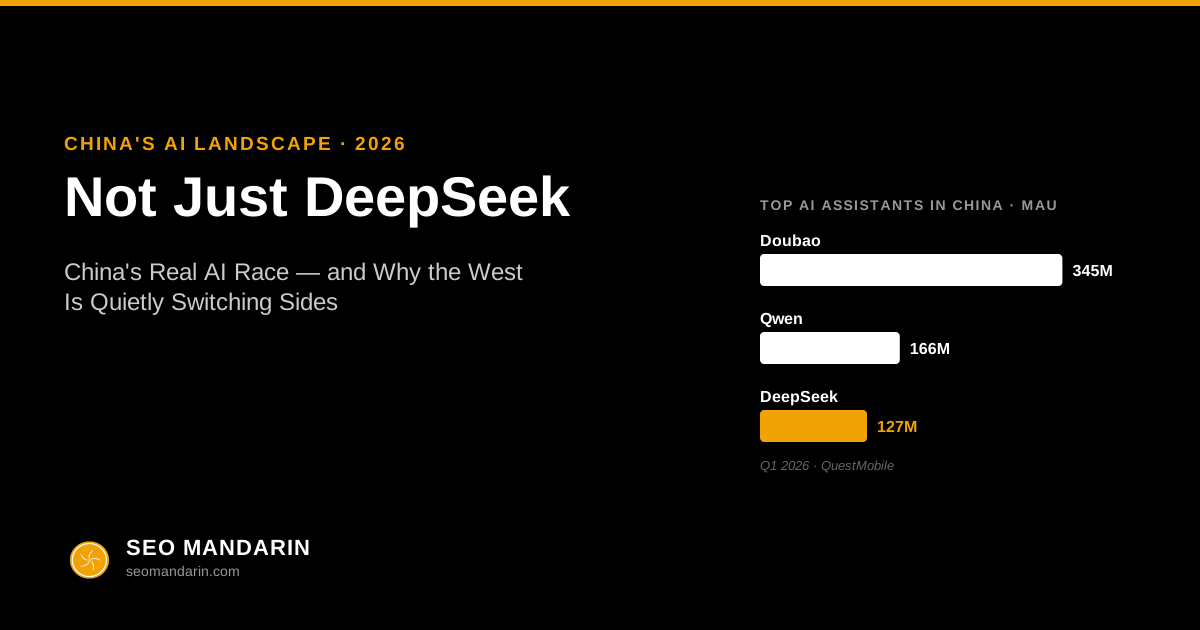
According to QuestMobile’s Spring 2026 data, the top AI apps in China by monthly active users are:
- Doubao (ByteDance) — 345 million MAU
- Qwen (Alibaba) — 166 million MAU
- DeepSeek — 127 million MAU
- Yuanbao (Tencent) — WeChat-native, riding the biggest distribution channel in China
- Kimi (Moonshot AI) — the researcher’s favorite, with massive context windows
Doubao isn’t just bigger. Its users open the app 54.8 times per month — nearly every single day — versus 41.7 for DeepSeek and 19.8 for Qwen. ByteDance won the same way it won short video: not with benchmarks, but with distribution (Douyin integration), multimodal features, and a product designed for your mother, not for engineers.
The lesson DeepSeek taught the world in January 2025 was “capability is catching up.” The lesson Doubao taught China afterwards was older and colder: distribution beats benchmarks.
Meanwhile, the user-acquisition war reached absurd scale. During the 2026 Spring Festival, ByteDance sponsored the CCTV New Year Gala; Alibaba reportedly spent around $430 million on giveaways for Qwen; Tencent poured another billion yuan behind Yuanbao. Prizes ranged from bubble tea to Mercedes-Benz cars.
The result: China’s AI-native apps now reach roughly 440 million monthly active users — and the land-grab phase is ending. ByteDance just introduced Doubao’s first paid tiers (¥68–500/month). Monetization season has begun.
China's Consumer AI War · Q1 2026
The One the West Knows Is Only #3
AI-native app users in China
440M
Market leader: Doubao
345M MAU
DeepSeek's share of top 3
~18%
Monthly Active Users
Engagement: Uses per User, per Month
The User-Acquisition Arms Race, Spring Festival 2026
Sponsored the CCTV New Year Gala to push Doubao
~$430M in giveaways to boost Qwen
~¥1B behind Yuanbao, prizes up to Mercedes cars
Sources: QuestMobile Spring 2026 report (March 2026 MAU and engagement); media reports on Spring Festival campaigns. seomandarin.com
The Enterprise Picture Looks Completely Different
Consumer market share tells you who won attention. The enterprise stack tells you who’s winning infrastructure — and it’s a different list:
- Baidu ERNIE leads enterprise API usage, tied into Baidu Cloud and government contracts.
- Zhipu AI (GLM-5) is the enterprise darling — MIT-licensed, and trained and served on Huawei’s domestic Ascend chips. For Chinese enterprises and state buyers, hardware independence matters more than a benchmark point.
- DeepSeek dominates a different category entirely: open-weight economics. When the question is “can I run this inside my own cloud?”, DeepSeek V3.2/V4 is on every shortlist.
- Kimi K2.5 (Moonshot) went all-in on the agent era — 1 trillion parameters, an “Agent Swarm” mode coordinating up to 100 agents, and pricing that undercuts Western equivalents by an order of magnitude.
Notice the pattern: China’s consumer war was won with distribution. Its enterprise war is being won with open weights and price.
Which brings us to the part nobody in the West wants to say out loud.
The Silent Switch to Chinese AI
On July 1st, Palantir CEO Alex Karp went on CNBC and said the quiet part loud: “Something has gone completely wrong.”
His argument: enterprises pay US frontier labs a fortune in token fees, get unclear ROI — and hand over something far more valuable in the process. In Karp’s words, the enterprise view has become: I’ll waste my time and money on tokens, get no value, “and they’re going to get my IP.”
Every prompt an enterprise sends to a closed API is a data transfer. Over time, Karp argues, that transfers a company’s “alpha” — its proprietary edge — to a third party that may eventually compete with it. Palantir’s answer was a 9-point “AI sovereignty” manifesto: own your compute, your models, your data stack.
You can dismiss this as Karp talking his book (Palantir sells the sovereignty layer). But look at what companies are actually doing:
- Coinbase cut its internal AI spend by nearly 50% by defaulting engineers to Chinese open-weight models — Zhipu’s GLM and Moonshot’s Kimi — through an internal gateway. Usage stayed high. Costs collapsed.
- Microsoft is reportedly evaluating a Microsoft-hosted, fine-tuned DeepSeek V4 as a lower-cost engine for Copilot’s agentic features.
- Cursor, one of the fastest-growing dev tools in the world, built its Composer 2 model on top of Kimi K2.5.
- On OpenRouter, Chinese providers went from under 2% of token traffic to over 45% in a single year — in some weeks exceeding 60%.
If you haven’t heard of OpenRouter: it’s a marketplace that sits between developers and AI models. Instead of signing up with OpenAI, Anthropic, Google and a dozen Chinese labs separately, a developer plugs into OpenRouter once and routes every request to whichever model is best — or cheapest — for the job. That’s what makes it the most honest scoreboard in AI: it strips away brand loyalty and marketing, leaving only what developers actually choose when every model costs real money and switching takes one line of code.
And on that scoreboard, American developers now route nearly half their AI workloads through Chinese models. Not out of ideology. Out of math: comparable capability at a fraction of the price, with weights you can host yourself — meaning your data and your IP never leave your building.
Chinese Open-Weight Models in the West · 2026
The Silent Switch, Measured in Tokens
OpenRouter token share, Apr 2025
<2%
OpenRouter token share, Apr 2026
45%+
Peak weeks in 2026
60%+
Share of OpenRouter Token Traffic, April 2026
Bar lengths are illustrative relative shares by provider — see verified aggregate figures above.
Xiaomi's MiMo-V2-Pro alone processes ~4.21T tokens per week — roughly 3× OpenAI's routed share. In February 2026, Chinese models held 4 of the top 5 positions by token consumption.
The Models — and Who in the West Runs on Them
Powers Cursor's Composer 2 coding model; part of Coinbase's internal AI gateway. Open weights, 1T parameters — topped OpenRouter's weekly chart with 856B tokens.
Default model for Coinbase engineers, helping cut internal AI spend by ~50% at steady usage. MIT-licensed — run it on your own servers, IP never leaves the building.
Reportedly under evaluation by Microsoft as a hosted, fine-tuned engine for Copilot's agentic features. Open weights; the shortlist default for self-hosted deployments.
The single most-used model on OpenRouter by a wide margin — chosen by developers for cost per token, coding and long context, not benchmark rank.
Sources: OpenRouter usage data via Q2 2026 provider reports; CNBC, Axios and company disclosures on enterprise adoption, June–July 2026. seomandarin.com
That’s the twist Karp identified: for a growing number of Western enterprises, the Chinese open-source model is the IP-safe option. The model runs on your servers. Nothing gets phoned home. The thing that was supposed to be the security risk became the security argument.
Why This Matters Even If You Never Touch an API
Two takeaways, depending on which side of this market you sit on.
If you’re a Western company watching AI costs: the open-weight ecosystem — much of it Chinese — is now a legitimate line item in your AI strategy, and your competitors are already using it. The capability gap that justified frontier pricing has narrowed to a few benchmark points; the price gap hasn’t.
If your business sells to Chinese consumers: the numbers above are your new marketing reality. Between Doubao, Qwen, DeepSeek, Yuanbao and Kimi, hundreds of millions of Chinese users now ask an AI assistant for answers — including “which brand should I buy?” And each of those engines names two or three brands per answer, not ten blue links.
Your Baidu ranking doesn’t decide whether Doubao recommends you. That’s a different game, with different rules — the one we cover in our guide to Generative Engine Optimisation for China.
How SEO Mandarin Tracks This Landscape
We monitor citation behaviour across Baidu Ernie, Doubao, DeepSeek, Qwen, Yuanbao and Kimi for every brand we work with, because “which AI assistant is winning” changes who your customers ask before they ask you. If your brand isn’t showing up when Chinese consumers ask these engines “which brand should I buy,” that’s a visibility gap — not a coincidence.
Question for you: has your company tested any Chinese open-weight models yet, or is that still off the table where you work? Genuinely curious where the line is right now.