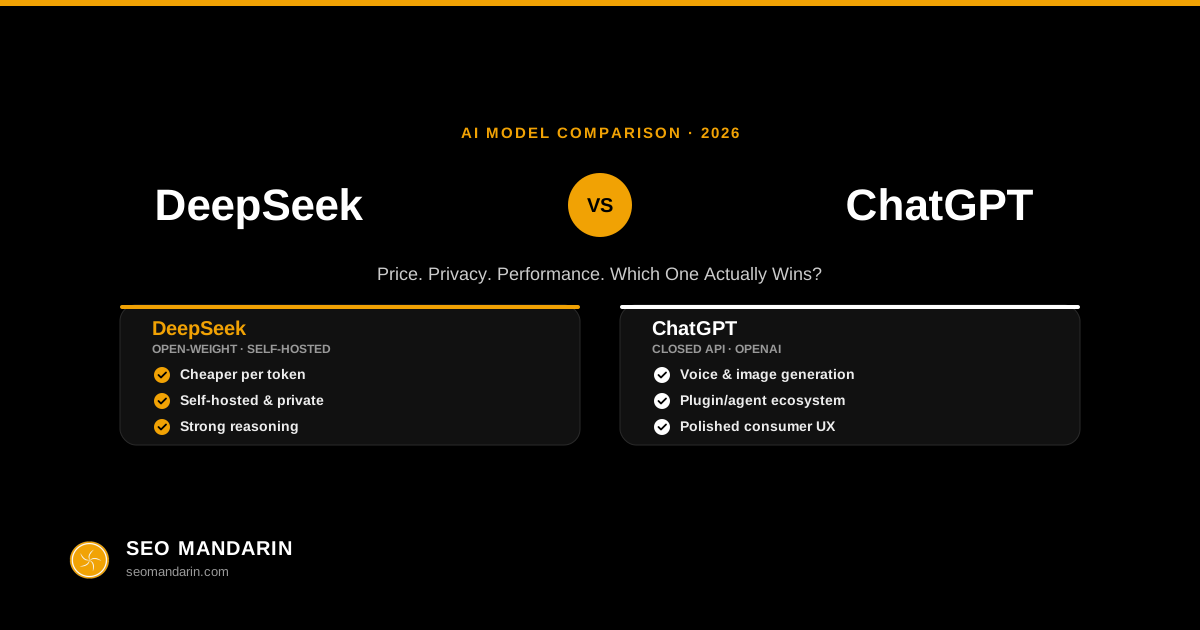
Short answer: DeepSeek wins on price and self-hosted data privacy; ChatGPT wins on polish, multimodal features, and ecosystem maturity. Which one is “better” depends entirely on what you’re optimizing for — and by the end of this guide you’ll know which.
“DeepSeek vs ChatGPT” is one of the most-searched AI comparisons of 2026, and for good reason: DeepSeek’s R1 model shocked the industry in January 2025 by matching frontier reasoning performance at a fraction of the cost, and the gap between the two hasn’t closed — it’s shifted. This guide breaks down exactly where each model wins, with a straight answer for whichever use case brought you here.
DeepSeek vs ChatGPT: Quick Answer
| If you care most about… | Winner |
|---|---|
| Lowest cost per token | DeepSeek |
| Self-hosting / data never leaving your servers | DeepSeek |
| Raw math and reasoning benchmarks | DeepSeek (competitive to ahead) |
| Voice, image, and video generation | ChatGPT |
| Plugin/agent ecosystem and app integrations | ChatGPT |
| Polished consumer chat experience | ChatGPT |
| Coding assistants and IDE tooling | Tied — both power major coding tools |
| Avoiding usage restrictions on sensitive topics | ChatGPT (different restrictions, not fewer) |
What Is DeepSeek?
DeepSeek is a Chinese AI lab that became a household name in January 2025, when its R1 model wiped hundreds of billions of dollars off Nvidia’s market cap in a single day and was labeled AI’s “Sputnik moment.” The reason: R1 matched Western frontier-model reasoning performance while reportedly costing a fraction as much to train and run.
What makes DeepSeek different from ChatGPT structurally is that its models (now on V3.2/V4) are open-weight — anyone can download and run them on their own infrastructure, rather than only accessing them through a paid API. That single fact is why DeepSeek shows up constantly in “cheapest AI model” and “self-hosted AI” searches, and why — as we cover in our deep-dive on China’s real AI race — a growing number of Western companies quietly run DeepSeek internally instead of paying for closed frontier APIs.
What Is ChatGPT?
ChatGPT is OpenAI’s consumer and enterprise AI assistant, built on the GPT model family. It’s the product most people picture when they hear “AI chatbot” — a polished app with voice mode, image generation, file uploads, custom GPTs, and deep integrations across browsers, Office apps, and third-party tools. Unlike DeepSeek, ChatGPT and its underlying GPT models are closed-source: you access them only through OpenAI’s API or apps, under OpenAI’s pricing and usage terms.
DeepSeek vs ChatGPT: Full Comparison Table
| Factor | DeepSeek | ChatGPT |
|---|---|---|
| Developer | DeepSeek (China) | OpenAI (US) |
| Model access | Open-weight — downloadable, self-hostable | Closed — API/app access only |
| Pricing | A fraction of frontier API pricing per token | Premium frontier pricing |
| Self-hosting | Yes — run entirely on your own infrastructure | No |
| Data privacy | Data never leaves your servers if self-hosted | Processed on OpenAI’s infrastructure |
| Reasoning/math benchmarks | Very strong, competitive with frontier models | Very strong, especially with reasoning modes |
| Coding | Strong; widely used as a backend for coding tools | Strong; deeply integrated into IDEs and dev tools |
| Multimodal (voice/image/video) | Limited compared to ChatGPT | Extensive — voice mode, image generation, vision |
| Ecosystem (plugins, agents, apps) | Growing, mostly via third-party integrations | Mature — Custom GPTs, Assistants, App integrations |
| Content restrictions | Avoids certain PRC-sensitive political topics | Different restrictions shaped by US content policy |
| Best for | Cost-sensitive teams, self-hosted/private deployments, high-volume API use | Consumer assistants, multimodal tasks, polished all-in-one products |
Pricing: DeepSeek Is Dramatically Cheaper
This is the single biggest reason “DeepSeek vs ChatGPT” trends the way it does. On a per-token basis, DeepSeek’s API pricing runs at a small fraction of what comparable frontier ChatGPT/GPT models cost — and because DeepSeek’s weights are open, teams with enough infrastructure can self-host it and pay only for compute, with no per-token fee to any vendor at all.
That price gap is exactly why developer platforms like OpenRouter have seen Chinese open-weight models — DeepSeek chief among them — grow from under 2% of routed token traffic in 2025 to well over 45% by 2026. It isn’t ideology; it’s teams doing the math on cost per token at scale. We cover the data behind that shift in detail in Not Just DeepSeek: China’s Real AI Race.
Performance: Reasoning, Coding, and Multimodal
Reasoning and math: DeepSeek’s R1 lineage was built specifically around chain-of-thought reasoning, and its successors remain genuinely competitive with — sometimes ahead of — ChatGPT’s reasoning modes on math and logic benchmarks. If your workload is heavy technical reasoning at scale, DeepSeek is a serious contender, not just a “budget option.”
Coding: Both models power serious coding tools. ChatGPT’s coding strength comes from tight IDE integrations and years of tool-use refinement; DeepSeek’s comes from strong benchmark performance at a much lower cost per request, which is why it’s popular as the backend model inside other companies’ coding products.
Multimodal: This is ChatGPT’s clearest advantage. Voice conversations, image generation, image understanding, and video-related features are more mature and more deeply integrated in ChatGPT than in DeepSeek’s current offering. If your use case depends on voice or vision, ChatGPT is currently the stronger choice.
Data Privacy: Where Does Your Data Actually Go?
This is where the two models diverge philosophically, not just technically.
With ChatGPT, every request is processed on OpenAI’s infrastructure, governed by OpenAI’s data-handling terms. Enterprise agreements exist, but the model itself never runs on your own servers.
With DeepSeek, because the weights are open, an organization can run the model entirely inside its own cloud or on-premises infrastructure. No prompt or output ever needs to leave the building. That’s precisely the argument Palantir CEO Alex Karp made in July 2026 when he called out the risk of enterprises leaking their “alpha” — their proprietary edge — to closed frontier labs one prompt at a time. It’s also why companies like Coinbase have shifted large portions of their internal AI usage to open-weight Chinese models specifically for this reason. Full details in Not Just DeepSeek.
Content Restrictions and Censorship
Neither model is unrestricted. DeepSeek, developed in China, is well documented to deflect or avoid certain topics considered politically sensitive within China. ChatGPT, developed in the US, applies its own different set of content policies shaped by US norms and OpenAI’s usage guidelines. Neither is a “neutral” baseline — they’re simply restricted differently, and which set of restrictions matters to you depends on your use case and jurisdiction.
Which Should You Use? A Decision Guide
- You’re cost-sensitive or running high-volume API calls → DeepSeek. The per-token savings compound fast at scale.
- You need data to never leave your own infrastructure → DeepSeek, self-hosted.
- You need voice, image generation, or a polished consumer-facing assistant → ChatGPT.
- You’re building on an existing plugin/agent ecosystem → ChatGPT currently has the deeper integrations.
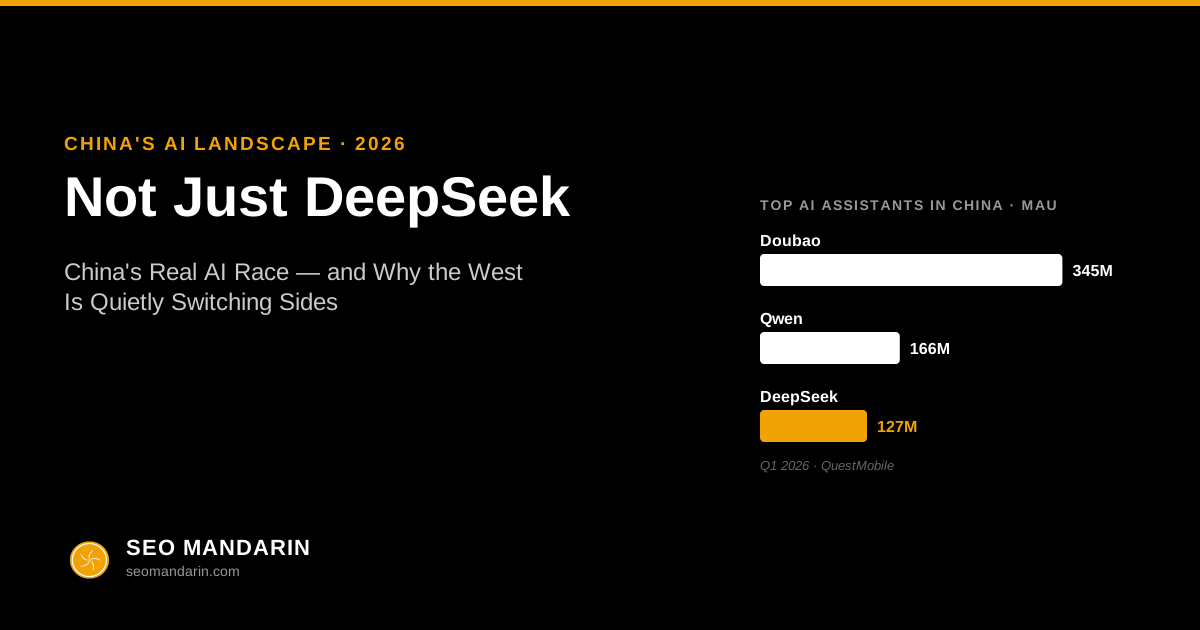
- You’re marketing to Chinese consumers and assumed DeepSeek was your target audience’s go-to AI → It probably isn’t. DeepSeek is only the third-most-used AI assistant inside China itself, behind Doubao (ByteDance) and Qwen (Alibaba). If Chinese consumer visibility is your actual goal, see Not Just DeepSeek: China’s Real AI Race for the real market breakdown.
Frequently Asked Questions
Is DeepSeek better than ChatGPT?
Neither is universally “better” — DeepSeek wins on price, self-hosting, and data privacy; ChatGPT wins on multimodal features and ecosystem maturity. The right choice depends on your specific use case.
Is DeepSeek cheaper than ChatGPT?
Yes, significantly. DeepSeek’s API pricing is a fraction of comparable frontier ChatGPT/GPT pricing per token, and self-hosting removes per-token API costs entirely.
Is DeepSeek safe to use for business data?
If self-hosted on your own infrastructure, DeepSeek’s open weights mean your data never has to leave your servers — which is why some enterprises consider it the more IP-safe option compared to sending data to a closed third-party API.
Can I run DeepSeek myself instead of using an API?
Yes. Because DeepSeek’s models are open-weight, you can download and run them on your own cloud or on-premises infrastructure, unlike ChatGPT, which is only accessible through OpenAI’s API or apps.
Does everyone in China use DeepSeek?
No. DeepSeek ranks third in China’s own consumer AI market, well behind Doubao (ByteDance) and Qwen (Alibaba). See our full breakdown of China’s AI landscape for the actual market-share data.
How SEO Mandarin Tracks the AI Landscape
Whether the question is “which AI model should my team use” or “which AI assistants actually influence Chinese consumers,” the answer keeps changing — and it rarely matches Western headlines. We track citation behavior and model adoption across both Western and Chinese AI ecosystems for every brand we work with, so recommendations are based on current data, not last year’s narrative.